
 Autoflower Seeds
 Feminized Seeds
 New Releases
 USA Cannabis Seeds
 High THC Strains
 High Yield Cannabis Strains
 Precision F1 Hybrids
 Washing Strains
 Cup Winning Cannabis Seeds
 Chill Out Cannabis Strains
 Amsterdam Cannabis Seeds Classics
 Best Taste & Aroma Cannabis Seeds
 Regular Seeds
 Merchandise
 Merchandise
 Blog
Blog Contact Us
 Wholesale Login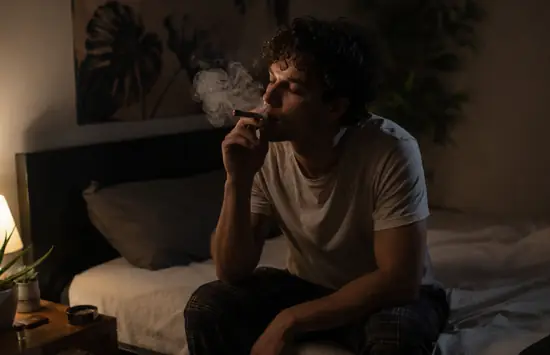
Cannabis and Dreams: Why Weed Stops You From Dreaming (And What Happens When You Quit)
Ask any longtime smoker about their dreams and most of them will shrug. They don’t have any. Or if they do, they can’t remember a thing about them by the time the coffee’s poured.
This isn’t laziness or bad memory. Something specific happens inside your brain when THC shows up at bedtime, and it has a measurable effect on the exact part of sleep where dreams actually live.
The flip side is just as wild. People who put the bong down after a long stretch of heavy use often get hit with a parade of bizarre, hyper-real dreams that feel like their brain dumped six months of suppressed footage in one long weekend.
There’s a real reason for all of this. It’s neuroscience, and once you understand how it works, the experience makes a lot more sense.
What actually happens in your brain while you sleep?
Sleep isn’t one long static state. Your brain runs through a cycle roughly every 90 minutes, churning through different phases each lap. Most of that time is spent in non-REM sleep, the slower-wave stages that handle physical recovery and basic memory filing.
Then there’s REM, short for rapid eye movement, which is the phase most people associate with dreaming. During REM, the eyes flicker behind closed lids, muscle tone drops to nearly zero, and the brain lights up with activity that looks a lot like being awake. Adults rack up about two hours of REM a night, split across four or five cycles, and the longest stretches happen in the hours right before you wake up.
That last part matters. If something cuts your sleep short, REM is the first thing you lose. And if something inside your sleep cycle keeps REM compressed across many nights, the effects on the brain start to pile up. Roughly 80% of vivid dream recall comes from REM sleep, which is why people who consistently lose REM also lose their sense of dreaming altogether.
Why don’t I dream when I smoke weed?
THC, the main psychoactive compound in cannabis, plays directly with how your brain regulates sleep stages. A 2025 systematic review and meta-analysis on cannabis and sleep architecture concluded that early high-dose THC trials consistently showed reduced REM sleep, while modern lower-dose studies have produced mixed results. The dose-dependent suppression of REM remains one of the most consistent findings across decades of research.
Plenty of people fall asleep faster after smoking. They also tend to sink deeper into the heavy non-REM stages. Both of those things feel good. They’re often the whole reason for using cannabis at night.
But while you’re drifting through deep slow-wave sleep, the REM stage is getting compressed. Less REM means fewer dreams, and the dreams that do slip through are harder to remember because THC also affects short-term memory consolidation. So even the dreams that survive often vanish before your eyes open. Stronger flower, larger doses, and consumption right before bed all crank this effect up.
What does losing REM sleep every night actually do to you?
Losing one night of REM isn’t a big deal. Losing it chronically is a different story. REM sleep is when the brain processes emotional memories, locks in learning from the day, and runs what some researchers describe as overnight emotional housekeeping.
Researchers at the University of Arizona have argued that modern society is in the middle of a “silent epidemic” of REM sleep loss driven by substances and medications, with cannabis and alcohol named among the main culprits. The downstream effects can include muted emotional regulation, slower learning consolidation, and a low-key sense of fogginess that’s hard to pin on any single cause.
Most people don’t notice the deficit because they have nothing to compare it to. The state becomes baseline. The body still gets the deep, restorative non-REM stages, so people often say they sleep great on cannabis. They’re partly right. The sedation is real. The dream phase is just quietly underbooked.
Why do my dreams come back so hard after I quit weed?
This is the part that catches people off guard. You quit smoking on a Tuesday, and by Friday you’re waking up at 4 AM convinced you were being chased through a parking lot by your high school principal who was also somehow a wolf.
This is REM rebound. The brain has been running a REM deficit for weeks, months, or years, and when the chemical cap comes off, the dream stage opens the floodgates. Margaret Haney, director of Columbia University’s Cannabis Research Laboratory, has described the mechanism plainly: whatever a drug does, when you take it away, the brain produces the opposite effect. With cannabis, that opposite is a surge of intense, emotionally charged, sometimes downright weird dreams.
Roughly 41% of cannabis-dependent patients in withdrawal report vivid dreams and 37% report strange ones, with the median duration of those withdrawal symptoms landing at 19 days. The dreams are part of how your sleep architecture rebuilds itself. Knowing that ahead of time takes some of the edge off when they start showing up.
How long do vivid dreams last after quitting weed?
The honest answer is a few weeks for most people, longer for some. Heavy daily smokers who’ve been at it for years tend to feel it hardest, with intense dreams sometimes lingering past the one-month mark. Lighter users may only get a wave for a week or two.
The peak usually hits inside the first ten days, when REM rebound is most aggressive and overall sleep is also choppy. Falling asleep gets weirder. You might wake up more during the night. None of this is pleasant in real time.
But it’s finite. The brain isn’t broken. It’s catching up on years of unfinished filing, and once that’s done, REM normalizes and dreams settle into a quieter rhythm. People riding out this stretch sometimes find it helps to keep a notebook by the bed. Scribbling the dream down, even badly, takes some of the emotional charge out of it and turns the experience into something almost interesting.
What 30 years of breeding has taught us at Barney’s Farm
Three decades of breeding and thousands of late-night conversations with growers and customers have shaped how we think about cannabis and rest at Barney’s Farm. The plant isn’t a one-shape-fits-all sleep aid. What knocks one smoker flat for fourteen hours leaves another wide awake and overthinking.
In our experience, cannabinoid percentages get most of the attention while terpenes quietly do a lot of the heavy lifting on the sedation side, particularly myrcene, linalool, and beta-caryophyllene. Genetics determine how much of those compounds end up in the final flower, and that’s where the breeding side of the equation matters more than most people realize.
Our breeding team has spent years tracking how different phenotypes behave in real-world use, and the pattern is pretty consistent. Heavier indica-leaning expressions tend to push the body deeper into non-REM sleep, which is exactly the trade-off most night smokers are making without thinking about it. Better sedation, less dreaming.
The same applies to potency. The bigger the THC hit before bed, the harder REM gets compressed, and the more likely you are to wake up unable to remember a single thing your brain was doing for eight hours. Smoking before bed has its place. The trade-off just deserves more thought than the usual “indica equals sleepy” shortcut. Understanding what cannabis actually does to sleep architecture lets you make a real decision about when, how often, and how much.
So should you stop smoking before bed?
That call is between you and your sleep. Some people smoke nightly for years and feel fine. Others figure out the trade after enough time and pull back. A tolerance break of two to three weeks is usually enough to see what unaided sleep actually looks like, including the dreams.
Even short dream cycles can be enough to feel sharper, more emotionally even, and less generally clouded. The dream chaos that comes with quitting is uncomfortable, but temporary, and a lot of people find the clarity on the other side worth the inconvenience.
Coming back to cannabis after a break is fine too. The point of any of this is doing it on purpose, knowing exactly what you’re trading. That’s the kind of relationship with the plant that holds up long-term.
Barney's Farm has been developing premium cannabis genetics since the 1980s, with over 40 Cannabis Cup wins. Explore our full cannabis seed catalog and find strains bred for every climate and skill level.