 Autoflower Seeds
 Feminized Seeds
 New Releases
 USA Cannabis Seeds
 High THC Strains
 High Yield Cannabis Strains
 Precision F1 Hybrids
 Washing Strains
 Cup Winning Cannabis Seeds
 Chill Out Cannabis Strains
 Amsterdam Cannabis Seeds Classics
 Best Taste & Aroma Cannabis Seeds
 Regular Seeds
 Merchandise
 Merchandise
 Blog
Blog Contact Us
 Wholesale Login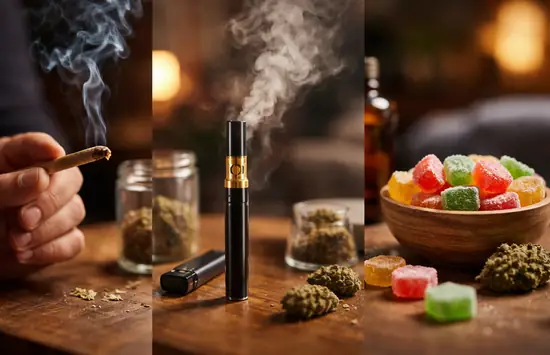
How Long Does a Weed High Last? (Smoking vs Edibles vs Vaping)
The question sounds simple. You smoke, eat, or vape some weed, and you want to know when you'll be back to baseline. Two hours? Four? Tomorrow morning? The answer depends on a bunch of variables, and anyone who gives you a single number is either lying or selling something. Probably both.
So let's break this down properly. Method by method, factor by factor, with actual science where it exists and honest experience where it doesn't.
Quick Reference by Method
For those who want the numbers without the reading:
Smoking: onset in minutes, peak at 15-30 minutes, main high 1-3 hours, aftereffects up to 5 hours.
Vaping: onset in minutes, peak at 15-30 minutes, main high 1-3 hours (often more intense per hit than smoking), aftereffects up to 5 hours.
Edibles: onset 30 minutes to 2 hours, peak at 2-4 hours, main high 4-8 hours, aftereffects up to 12+ hours.
These are ranges, not guarantees. Your body, your dose, your strain, and your tolerance all move the needle.
Smoking: The Classic
Smoking flower remains the most common way people consume cannabis worldwide. The timeline is straightforward and predictable, which is exactly why it's stuck around since roughly forever.
When you inhale cannabis smoke, THC crosses the thin membrane of your lungs and hits your bloodstream almost immediately. You'll feel the first effects within seconds to a few minutes. Peak high arrives somewhere around 15 to 30 minutes in. The main ride lasts about 1 to 3 hours for most people, though residual effects can linger for another hour or two after that.
There's comfort in that predictability. You take a hit, you feel it fast, you know where you are. If you're an experienced smoker, you can titrate your dose in real time. Too strong? Stop smoking. Want more? Take another hit. That feedback loop is a big part of why smoking has never really gone out of style.
Your mileage will vary depending on the strain's THC content, how deeply you inhale, how long you hold it, and whether you've eaten recently. A 15% THC flower and a 30% THC flower are going to tell two very different stories over the same three-hour window. At Barney's Farm, we've spent decades breeding strains across that entire spectrum, and from working with genetics like Mimosa x Orange Punch (30% THC) versus something mellower, we can tell you firsthand: potency dramatically shapes the duration curve. Higher THC strains tend to produce a longer tail on the high, not just more intensity.
The other wildcard is tolerance. Daily smokers will generally have shorter, less intense highs compared to someone who lights up once a month. Your endocannabinoid system adapts. The receptors downregulate. This is why longtime users sometimes wonder if their weed "stopped working." It didn't. Your brain just got used to it.
Vaping: Familiar but Different
Vaping cannabis heats the flower or concentrate to a temperature that releases cannabinoids and terpenes as vapor, without combustion. The onset and duration are similar to smoking on paper, but there's a twist.
A 2018 Johns Hopkins study compared smoking and vaping the same doses of THC in infrequent cannabis users and found that vaping produced significantly stronger effects across the board. At the 25mg dose, blood THC levels averaged 14.4 ng/mL when vaped versus 10.2 ng/mL when smoked. Participants reported more pronounced highs, more impairment, and more adverse reactions from vaping. Two participants vomited after vaping. One experienced hallucinations.
The duration of a vaping high is roughly similar to smoking: 1 to 3 hours for the main event. But because vaporizers are more efficient at extracting cannabinoids (no burning means less waste), you often get more THC per hit than from a joint. That efficiency changes the experience. People new to vaping sometimes apply their smoking habits to a vape pen and end up much higher than expected.
With concentrates, the numbers go even further. Vape cartridges commonly contain 70% to 90% THC. Compare that to most flower at 15% to 30%. The math is obvious. A single hit from a concentrate pen can deliver more THC than several hits from a joint. The duration doesn't necessarily stretch out much further, but the intensity spike means the high can feel longer simply because it takes more time to come down from a steeper peak.
Edibles: The Long Game
Edibles are a fundamentally different animal. When you eat cannabis, THC travels through your digestive system to your liver before reaching your brain. That detour changes everything.
In the liver, THC gets converted into a metabolite called 11-hydroxy-THC. This metabolite crosses the blood-brain barrier more efficiently than regular THC and binds more tightly to CB1 receptors. Research on animals suggests 11-hydroxy-THC may be somewhere between 1.5 to 7 times more potent than the THC you inhale. That conversion process is the whole reason edibles hit so differently. You're literally consuming a different compound by the time it reaches your brain.
Edible onset is slow. Expect 30 minutes to 2 hours before you feel anything. Peak effects usually hit around 2 to 4 hours after eating. And the total duration? Anywhere from 4 to 8 hours, with some high-dose experiences lasting 12 hours or longer. Residual grogginess the next morning is common, especially for newer users or anyone who went a bit heavy on the dosage.
This slow onset is where people get into trouble. You eat a gummy, feel nothing after an hour, eat another one, and then both kick in at once like a freight train. A study published in the Annals of Internal Medicine looked at cannabis-related emergency room visits at a Colorado hospital between 2012 and 2016. Edibles accounted for less than 1% of total cannabis sales by THC content in the state, but were behind roughly 11% of cannabis-related ER visits. That's a massive disparity. Most of those visits involved psychiatric symptoms: panic attacks, acute anxiety, psychosis episodes. NBC News covered the findings, and researchers pointed to the delayed onset as a primary culprit. People simply don't wait long enough.
The golden rule with edibles has been repeated a thousand times because it keeps being true: start with 5mg of THC or less. Wait at least two hours. Then decide.
The Variables Nobody Talks About Enough
Beyond method of consumption, several personal factors shape how long your high lasts. These get overlooked constantly.
Body composition matters. THC is fat-soluble. People with higher body fat percentages may store more THC in their adipose tissue, which can extend the tail end of a high as it slowly releases back into the bloodstream. This is part of why the same edible can feel like a 4-hour experience for one person and an 8-hour one for another.
Metabolism is the other big one. Faster metabolisms process THC more quickly. This means quicker onset, potentially more intensity, but shorter overall duration. Slower metabolisms extend the timeline in both directions.
Food in your stomach changes the game for edibles specifically. A high-fat meal consumed before or alongside an edible can significantly increase THC absorption. Your body is better at processing THC when there's fat present to carry it through the digestive process.
Terpene profiles also play a role that the industry is only beginning to understand. At Barney's Farm, we've observed through over 30 years of breeding that strains with dominant myrcene profiles tend to produce heavier, longer-lasting body effects, while limonene-dominant strains often create a lighter, shorter experience. We've refined our genetics library specifically around these terpene profiles because we've seen how much they shape the real-world experience. Our breeding team tracks not just THC and CBD levels but the full terpene spectrum of every phenotype we select. When someone says a particular strain "lasts longer" or "hits different," terpenes are usually part of the explanation.
Tolerance, as mentioned, is the silent modifier. Frequent users process THC more efficiently and experience shorter highs. If you feel like your sessions have gotten shorter and less interesting, a tolerance break of even a few days can make a noticeable difference.
What To Do If You're Too High
It happens. Even to veterans. Here are a few things that actually help.
Stop consuming. Obvious, but people forget. If you're already uncomfortably high, adding more is not going to improve the situation.
Black pepper. Chewing a few peppercorns or even just sniffing ground black pepper can help take the edge off. The terpene beta-caryophyllene, found in high concentrations in black pepper, interacts with CB2 receptors and may help modulate the anxiety that comes with overconsumption. This is old stoner wisdom that actually has a pharmacological basis.
Cold water on your face or wrists. It triggers a mild shock response that can pull you back into the present moment. Deep breathing works for the same reason.
Sleep. If you can sleep, do it. Your body will process the THC while you rest, and you'll wake up feeling significantly better. This is especially true with edibles, where the remaining duration might be several hours.
Time. There is no shortcut past the clock. THC will metabolize. You will come down. No one has ever stayed high forever, regardless of how convincing the panic in that moment can be.
Bottom Line
How long does a weed high last? The honest answer: 1 to 3 hours for smoking and vaping, 4 to 8 hours (or more) for edibles. Everything else is personal variables stacked on top.
Know your method. Know your dose. Know your strain. And when in doubt, start low and go slow. The weed will still be there when you're ready for more.
Barney's Farm has been developing premium cannabis genetics since the 1980s, with over 40 Cannabis Cup wins. Explore our full seed catalog and find strains bred for every climate and skill level.