
 Autoflower Seeds
 Feminized Seeds
 New Releases
 USA Cannabis Seeds
 High THC Strains
 High Yield Cannabis Strains
 Precision F1 Hybrids
 Washing Strains
 Cup Winning Cannabis Seeds
 Chill Out Cannabis Strains
 Amsterdam Cannabis Seeds Classics
 Best Taste & Aroma Cannabis Seeds
 Regular Seeds
 Merchandise
 Merchandise
 Blog
Blog Contact Us
 Wholesale Login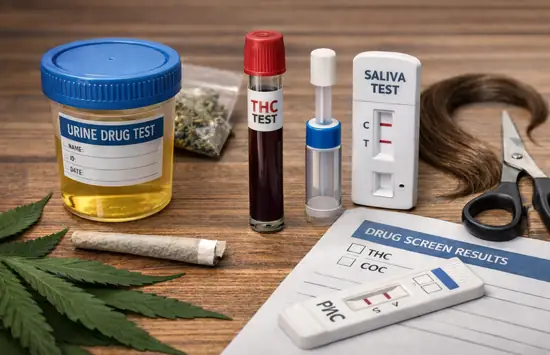
How Long Does THC Stay in Your System? (Drug Test Breakdown by Type)
So you've got a weed drug test coming up. Maybe it's for a new job. Maybe it's for probation. Maybe your weird uncle just bought a home testing kit and won't shut up about it. Whatever the reason, you need answers, and you need them straight. How long does THC stay in your system? Let's get into it.
The Short Answer (For People in a Hurry)
THC detection time depends on three things: how often you smoke, what kind of test you're taking, and your body's own quirks. A one-time session can show up for about 3 days in urine. Daily use? That stretches to 15 days or more. Heavy, chronic use can keep you testing positive for 30+ days after your last hit.
But those numbers are only part of the picture. The type of drug test changes everything.
Why THC Sticks Around So Long
Here's the thing that separates cannabis from basically every other substance on the planet: THC is fat-soluble. Your body doesn't just flush it like alcohol or caffeine. Instead, THC and its metabolites (mainly THC-COOH, the non-psychoactive byproduct your liver creates) get tucked away in your fat cells like a squirrel hoarding acorns for winter.
Over time, those stored metabolites slowly leak back into your bloodstream, pass through your liver again, and eventually get excreted through urine and feces. Roughly 65% exits through your bowels and about 20% through urine. The rest just hangs out in your body, taking its sweet time.
This is why a single smoke session clears your system in days, but regular use creates a backlog of stored metabolites that takes weeks to work through. The half-life of THC (meaning the time it takes for half the concentration to leave your body) is around 1.3 days for occasional users. For frequent users, that half-life balloons to somewhere between 5 and 13 days.
At Barney's Farm, we've spent nearly 40 years breeding cannabis genetics across the globe, from the Himalayas to the US West Coast. One thing we know from decades of working with hundreds of strains is that cannabinoid profiles vary wildly. A high-THC powerhouse strain will obviously leave more metabolites in your system than a mellow CBD-rich cultivar. The strain you choose matters more than most people think when it comes to how long marijuana stays in urine.
Drug Test Breakdown by Type
Urine Test (The Most Common)
This is what most employers use. It's cheap, fast, and can return results in about 10 minutes. Urine tests don't look for THC itself. They look for THC-COOH, the metabolite your liver produces after processing THC. The standard cutoff used in the US is 50 ng/mL, though some labs use a stricter 20 ng/mL threshold.
Here's how long does marijuana stay in urine, based on usage:
Single use: Up to 3 days
Moderate use (a few times per week): 5 to 7 days
Daily use: 10 to 15 days
Heavy daily use: 30+ days
These are approximations. Your individual metabolism, body fat percentage, hydration level, and exercise habits all play a role. A lean person with a fast metabolism will clear THC far quicker than someone carrying more body fat, because there's simply less fatty tissue for the metabolites to hide in.
Blood Test
Blood tests detect active delta-9-THC, not the metabolite. That means they catch recent use, not something you did two weeks ago. THC hits your bloodstream within minutes of inhaling and peaks fast, but concentrations drop sharply within 3 to 4 hours. Detection window? Roughly 12 to 24 hours for most people.
Blood tests are mostly used in accident investigations and DUI cases, where proving current impairment matters more than proving past use. They're invasive and expensive, so employers rarely bother with them.
Saliva Test (Mouth Swab)
The mouth swab is gaining popularity because it's quick, non-invasive, and hard to cheat. A sponge on a stick rubs along the inside of your cheek, and that's it. Saliva tests pick up parent THC, not metabolites, so the window is short: typically up to 24 hours, though some research shows detection is possible up to 30 hours after a single THC cigarette.
Worth noting: there's significant THC absorption in the mouth itself during smoking, which temporarily spikes oral concentrations. If you smoked a few hours ago, a mouth swab will probably catch you. If it's been a full day, you're most likely fine.
Hair Test
Hair testing is the long game. Metabolites get locked into hair's keratin structure as it grows, creating a recorded timeline of your drug use. Standard protocol takes the most recent 1.5 inches of scalp hair, which covers roughly 90 days of history.
But here's the catch that doesn't get talked about enough: hair tests are unreliable for occasional users. Research has shown that roughly 75% of self-reported heavy users tested positive via hair sample, while only about 39% of light users did. If you smoke once at a party and then nothing for three months, a hair test might not catch it. If you're a daily consumer, it almost certainly will.
The Potency Factor: Why Modern Weed Hits Different
Here's something that directly affects THC detection time: cannabis today is significantly stronger than what people were smoking decades ago. A study from the University of Mississippi analyzing DEA-seized cannabis samples found that average THC concentrations rose from about 4% in 1995 to roughly 12% in 2014. Research from the University of Bath published in the journal Addiction confirmed this trend internationally, finding THC concentrations in herbal cannabis increased by 14% between 1970 and 2017, with resin products showing an even steeper 24% rise in THC.
That matters for drug tests. More THC going in means more metabolites stored in fat, which means a longer detection window. A couple of hits from a 25%+ THC strain deposits meaningfully more metabolites than the same number of hits from something at 10%. The math is simple, and the implications are real.
As breeders, we at Barney's Farm have watched this evolution firsthand. Our scientific breeding programmes have consistently optimized cannabinoid profiles across our strain catalogue, and we lab-test every batch to verify potency and content. We know the difference between a strain clocking in at 15% THC and one pushing past 28%. That gap has a direct impact on how long your body spends processing it all.
What About Edibles?
Edibles follow a different metabolic path. When you eat cannabis, THC goes through your digestive system and gets processed by the liver into 11-hydroxy-THC, a metabolite that's actually more potent than regular THC. This is why edibles feel stronger and last longer.
From a drug testing perspective, edibles don't create a fundamentally different detection window than smoking. The same urine, blood, and hair test windows apply. But because edibles tend to deliver higher effective doses (people often eat more than they'd smoke), there can be more metabolites to clear. If you ate a 50mg edible versus taking a single bong rip, your body has more work to do.
What Actually Works for Clearing THC Faster
Let's be blunt (pun intended): there is no scientifically proven way to speed up THC elimination from your body. Detox kits, cranberry juice cleanses, niacin protocols, and excessive water consumption are all marketed heavily, but none have reliable evidence behind them. Some detox products are unregulated and can even be harmful.
The only guaranteed method is time and abstinence. Your body will clear THC at its own pace, and that pace depends on your metabolism, body composition, and usage history.
That said, a few things can theoretically support the process. Regular exercise burns fat, which is where THC hides. Staying hydrated supports your kidneys. Eating a diet rich in fiber may help, since the majority of THC metabolites exit through fecal matter. But none of these are magic bullets, and none will save you if your test is tomorrow.
The Bottom Line
How long does THC stay in your system? Anywhere from a day to over three months, depending on the test and your usage. Urine tests dominate the landscape, and for the average person who smokes a few times a week, that means a detection window of about 5 to 7 days. Heavy users should plan on a month or more.
Know your rights, know your state's laws, and know your body. The cannabis world is shifting fast under our feet, but drug testing technology hasn't kept up. Until it does, the best strategy is to understand exactly what you're dealing with and plan accordingly.
Barney's Farm has been developing premium cannabis genetics since the 1980s, with over 40 Cannabis Cup wins. Explore our full seed catalog and find strains bred for every climate and skill level.