
 Autoflower Seeds
 Feminized Seeds
 New Releases
 USA Cannabis Seeds
 High THC Strains
 High Yield Cannabis Strains
 Precision F1 Hybrids
 Washing Strains
 Cup Winning Cannabis Seeds
 Chill Out Cannabis Strains
 Amsterdam Cannabis Seeds Classics
 Best Taste & Aroma Cannabis Seeds
 Regular Seeds
 Merchandise
 Merchandise
 Blog
Blog Contact Us
 Wholesale Login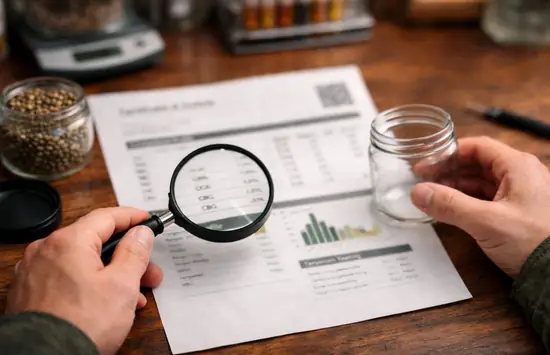
How to Read a Cannabis Lab Report Like You Know What You're Looking For
You pick up a jar from the dispensary shelf, flip it around, and there it is: a tiny QR code, a few percentages, and maybe a terpene chart that looks like something from a chemistry exam you never studied for. Most people glance at the THC number, nod, and move on. That number barely scratches the surface of what the product actually contains.
Every legal cannabis product goes through laboratory testing before it reaches you. The results get compiled into a document called a Certificate of Analysis, or COA. Think of it as the product's full biography. The label on the jar is the blurb on the back cover. The COA is the whole story, including the parts the blurb left out.
Here's how to read it without needing a lab coat.
What a COA Actually Is
A Certificate of Analysis is a report produced by a licensed, third-party testing laboratory. It documents everything from cannabinoid potency to the presence (or absence) of pesticides, heavy metals, mold, residual solvents, and microbial contaminants. In most legal U.S. states, dispensaries are required to make COAs available for every product on the shelf. You can usually access one by scanning the QR code on the packaging or by asking your budtender directly.
The document will look dense. Lots of abbreviations, columns of numbers, pass/fail markers. But the core sections are consistent across labs, and once you know what to look for, they become second nature.
Stop Chasing THC Percentages
The THC number on the label is the most looked-at and least understood figure in cannabis retail. Higher THC does not automatically mean a better experience. At Barney's Farm, we've seen this play out across decades of breeding: a strain with 18% THC and a rich terpene profile can deliver a far more complex, satisfying session than a 30% THC flower that's been stripped of everything interesting during aggressive cultivation.
There's also a real accuracy problem. A 2025 study published in Scientific Reports audited 277 cannabis products from 52 Colorado dispensaries and found that roughly 44% of flower products were inaccurately labeled for THC, with most overstating their potency. One flower product claimed 24% THC on the label. The lab measured 16%. That's a significant gap. Concentrate products fared much better, with 96% testing within range.
Why does this happen? Third-party labs compete for business. Producers want high numbers because high numbers sell. The plant itself is also naturally variable. A bud from the top of the canopy might test differently from one pulled off a lower branch. Testing a homogeneous oil is far easier than testing a biological organism with variable density and cannabinoid distribution.
So when you look at the THC percentage on a label, treat it as an estimate, not a guarantee. The COA will give you the tested number. Compare it to the label. If they don't match, that tells you something about the producer's standards.
Reading the Cannabinoid Profile
The cannabinoid section of a COA lists every detected compound by concentration, usually expressed both in mg/g and as a percentage of total weight. You'll see familiar names like THC, CBD, and maybe CBN. But the interesting details are in the less prominent lines.
A few things to understand here. The COA often lists THCA and THC separately. THCA is the raw, acidic form of THC that exists in the living plant. When you smoke or vaporize flower, heat converts THCA into THC through a process called decarboxylation. The "Total THC" number on your COA is calculated using the following formula: Total THC = (0.877 × THCA) + THC. That 0.877 multiplier reflects the weight lost during the conversion, when THCA sheds a CO2 molecule to become THC.
At Barney's Farm, we breed with the full cannabinoid spectrum in mind. We pay attention to minor cannabinoids like CBG (cannabigerol), which appears early in the plant's life cycle and converts into other cannabinoids as the flower matures. CBC (cannabichromene) and CBN (cannabinol, which forms as THC degrades over time) are also worth tracking. Each contributes something different to the overall experience. When a COA shows detectable levels of several minor cannabinoids alongside the dominant ones, that's an indicator of a well-grown, properly harvested plant.
If a COA shows only THC and nothing else of note, you're looking at flower that was bred and grown to do one thing: hit hard. Nothing wrong with that if it's what you're after. But if you want depth, look for variety in the cannabinoid panel.
The Terpene Profile Is Where the Real Information Lives
Terpenes are aromatic compounds responsible for the way cannabis smells and tastes. Limonene gives that citrus punch. Myrcene has a musky, earthy quality. Pinene smells like walking through a pine forest. They exist in hundreds of plants beyond cannabis, but in cannabis, they do more than contribute aroma.
A 2021 study from the University of Arizona, published in Scientific Reports, found that cannabis terpenes activated CB1 cannabinoid receptors on their own and amplified the pain-relieving effects of cannabinoids when combined with them. The researchers tested alpha-humulene, geraniol, linalool, and beta-pinene. Each terpene, used individually, reduced pain sensitivity in laboratory models. When combined with a cannabinoid agonist, the pain relief increased beyond what either compound achieved alone, without a corresponding increase in negative side effects.
This is the core of what's called the entourage effect: the idea that cannabis compounds work together, and the whole plant produces results that isolated compounds can't replicate on their own. The theory is still being studied and debated, but preliminary evidence keeps stacking up in its favor.
At Barney's Farm, terpene profiles have always been central to how we develop and select our genetics. When we evaluate a new phenotype, terpene expression is weighted as heavily as potency. Two plants can have identical THC levels and produce wildly different experiences based on their terpene chemistry. This is why strain-specific effects exist despite the "indica vs. sativa" framework being genetically outdated. The terpenes are doing the heavy lifting.
When you look at a COA's terpene section, pay attention to the dominant terpenes and their concentrations. A flower with 2% total terpenes will generally have greater aromatic complexity and a more nuanced effect than one with less than 1%. The specific terpenes present tell you about what kind of experience to expect. Caryophyllene-dominant strains often have a spicier, peppery feel. Linalool-heavy profiles tend to be calming. Limonene brings energy and brightness.
Not every COA includes terpene testing. Some states don't require it. If a producer includes it voluntarily, that's usually a good sign they care about the full picture.
The Safety Panel: What Should Say "Pass"
This is the section people skip, and it's arguably the most important one. The contaminant testing panel checks for substances that have no business being in your body.
Heavy metals testing screens for lead, arsenic, cadmium, and mercury. Cannabis is a bioaccumulator, meaning it pulls contaminants from the soil it grows in. If the growing medium contains heavy metals, the plant will absorb them. Results are measured in parts per million (ppm) or parts per billion (ppb), with action levels set by each state's regulatory framework.
Pesticide screening checks for residues from chemicals used during cultivation. Even in legal markets, not every grower follows organic practices. The COA will list specific pesticides tested and their detected levels. Everything should fall below the state-mandated threshold.
Microbial testing looks for bacteria like E. coli and Salmonella, as well as mold and yeast. Cannabis product testing became a formalized practice as legal markets recognized that agricultural products consumed through inhalation carry unique risks. Mold on a tomato might give you a stomachache. Mold on cannabis flower that you inhale can cause serious respiratory problems, especially for immunocompromised users.
Residual solvent testing applies primarily to extracts and concentrates. If a product was made using butane, propane, ethanol, or CO2 extraction, the COA confirms that solvent levels have been purged to safe limits.
Every test on this panel should read "PASS." If any section shows a failure, that product should never have reached the shelf. If you're reviewing a COA and see a fail marker anywhere, walk away.
Labels Lie More Often Than You'd Think
There's a documented gap between what cannabis labels claim and what laboratory testing reveals. A landmark 2017 study published in JAMA analyzed 84 CBD products sold online and found that roughly 70% were mislabeled. About 43% contained more CBD than advertised. About 26% contained less. And 21% of the products tested positive for THC that wasn't mentioned on the label at all.
The situation has improved in tightly regulated state markets, but inaccuracies persist. A 2025 analysis from STAT News examined cannabis product warning requirements across all 25 U.S. jurisdictions that have legalized and found that only six earned top marks for adequate consumer-facing labeling standards. Most states scored poorly, with several receiving a D or F.
This is exactly why the COA exists as a separate document from the label. The label is marketing. The COA is data. When the two don't match, trust the COA.
Putting It All Together
Reading a COA gets easier fast. After your first three or four, you'll develop a rhythm. Scan the header to confirm the product and batch number match your jar. Check the cannabinoid profile for the full spectrum of what's present. Look at the terpene section if available. Confirm that every contaminant test says "PASS." Compare the tested THC to what the label claims.
The information is there. You paid for the product. You have every right to see the full breakdown. Next time you're at the dispensary, pull up the COA before you buy. If the dispensary can't provide one, ask yourself why. And if they can, you now know exactly what you're looking at.
Barney's Farm has been developing premium cannabis genetics since the 1980s, with over 40 Cannabis Cup wins. Explore our full seed catalog and find strains bred for every climate and skill level.