
 Autoflower Seeds
 Feminized Seeds
 New Releases
 USA Cannabis Seeds
 High THC Strains
 High Yield Cannabis Strains
 Precision F1 Hybrids
 Washing Strains
 Cup Winning Cannabis Seeds
 Chill Out Cannabis Strains
 Amsterdam Cannabis Seeds Classics
 Best Taste & Aroma Cannabis Seeds
 Regular Seeds
 Merchandise
 Merchandise
 Blog
Blog Contact Us
 Wholesale Login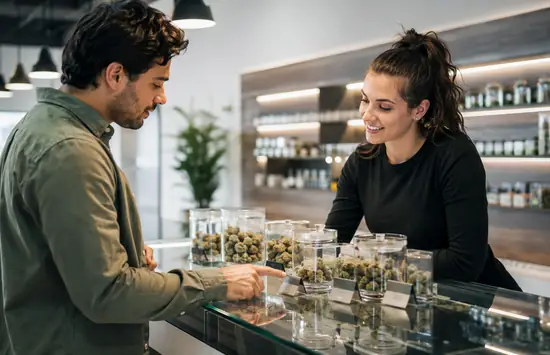
How to Read a Dispensary Menu Without Looking Like a Tourist
Walking into a dispensary for the first time can feel like landing in a country whose alphabet you almost recognize. The display cases glow, the staff is younger than your dentist, and the menu reads halfway between a chemistry textbook and a Brooklyn ice cream shop. Twenty cookie-named hybrids. THC numbers stacked like baseball stats. Eighths, halves, ounces, prerolls, vapes, edibles, tinctures, topicals, live rosin, RSO. Breathe. The menu makes sense once you know what you’re looking at. This is the cheat sheet.
What’s actually on a dispensary menu?
Every shop sets up its menu a little differently, but the categories barely change from state to state.
<{$tag} class="blog__ul">That’s the whole map. Once you know which category you came in for, the menu shrinks dramatically.
What does the THC percentage actually mean?
That big number next to every flower strain is the percentage of THC by dry weight. Most dispensary flower in 2026 lands somewhere between 18% and 30%, and it’s worth knowing that this is not what your uncle was smoking at Lollapalooza in 1995. The potency of cannabis samples in the US rose by more than 300% between 1995 and around 2017, and the breeding hasn’t stopped. Concentrates can hit 70-90% THC, which is a different planet entirely.
Here’s the part most beginners miss: chasing the highest THC number on the menu is a rookie move. THC is a strength rating. It says nothing about flavor, balance, or how the high will actually feel. A 32% jar with no terpenes can feel like a brick to the head with no flavor, and a 22% jar with a complex terpene profile can put you in a much better mood. Buy on smell and lab results, not the headline number.
Are indica, sativa, and hybrid still useful labels?
Yes and no. The classic shorthand is that indica relaxes you (the “in da couch” mnemonic) and sativa lifts you up. After 30+ years of breeding cannabis, our team can tell you that the indica/sativa labels at a modern dispensary tell you less about the experience than the lab report does. A genomic analysis of hundreds of cannabis samples found that strains labeled indica were often as genetically close to sativa-labeled strains as they were to other indicas. The labels don’t track the chemistry the way most people assume.
Almost everything on a menu today is a hybrid of a hybrid of a hybrid. Genetic ancestry doesn’t always map cleanly onto effect. That doesn’t make the labels useless. They give you a starting direction. The smarter move is to treat them as a rough vibe and read the terpenes underneath.
A good example is Blue Dream, which you’ll see on practically every dispensary menu in America. It gets sold as a sativa-leaning hybrid, but ask ten people who’ve smoked it how it hits and you’ll get ten different answers. Our Blue Dream descends from the same Haze and Blueberry lineage that put the strain on the map, and the reason it’s everywhere is that the effect lands somewhere in the middle no matter what the label says.
What are terpenes, and why are they on the menu now?
Terpenes are aromatic oils that give cannabis its smell. The same chemicals are why lemons smell like lemons, pine forests smell like pine, and mangoes smell like mangoes. A few you’ll see listed on better dispensary menus:
<{$tag} class="blog__ul">The theory floating around dispensary culture is the “entourage effect”: the idea that cannabinoids and terpenes work together to shape the experience. A recent peer-reviewed systematic review noted that while exploratory evidence suggests terpenes may influence cannabinoid effects, the synergistic enhancement remains unproven and more clinical trials are needed. So treat the terpene profile as a strong hint about flavor and likely effect, not a guarantee. Smell the jar. Trust your nose more than the marketing copy.
How to decode strain names that sound like dessert orders
Modern strain naming follows trends. Most dispensary menus break down into a handful of recurring families:
<{$tag} class="blog__ul">Names usually tell you something about the lineage. Anything in the cake or cookie family probably has GSC (Girl Scout Cookies) somewhere in its parents. Anything called “Punch” probably has Purple Punch in it. Anything with “Haze” leans sativa. Anything with “Kush” leans indica. Our team has bred enough crosses to confirm what people pick up intuitively: the name is shorthand for the family tree, and the family tree is shorthand for what the buds actually do.
Wedding Cake is a clean example of how the naming convention matures. It’s an indica-dominant cross of Triangle Kush and Animal Mints, sweet and dense, and the name tells you what to expect: rich, dessert-leaning, chill. We’ve been running our Wedding Cake selection for years and it pulls 27% THC consistently. That comes from stable genetics, period.
How do you actually use a budtender?
At a dispensary counter, the number-one rookie mistake is asking for “the strongest thing you have.” The number-two mistake is naming a strain you read about online and refusing to deviate. Think of a budtender as a knowledgeable friend at a record store. Walk in with the outcome you want. Try lines like:
<{$tag} class="blog__ul">Tell them your tolerance honestly. Tell them how long it’s been since you last smoked. Ask when the flower was harvested. Anything older than four months has lost a lot of its terpene punch. Ask to smell the jar if the dispensary allows it. A good budtender will steer you toward something fresher, more interesting, and probably cheaper than whatever you came in chasing.
One last thing on edibles, because this is where first-timers get themselves in trouble: start at 5mg or less if you’re new, and wait at least 90 minutes before even thinking about a second dose. Smoked cannabis kicks in within minutes. Edibles can take an hour or more, and the rookie move is to assume nothing’s working and double up. That’s the most common reason new users end up sweating on a couch wondering if they need an ambulance. They don’t. They just need water, a snack, and a distraction.
How do you read the prices on a dispensary menu?
Cannabis is sold by weight in some pretty old-school units:
<{$tag} class="blog__ul">Edibles are sold by total milligrams of THC and per-piece dose. A 100mg gummy pack with 10 gummies works out to 10mg per gummy. Vapes are usually 0.5g or 1g cartridges. Concentrates are usually sold by the gram.
Prices vary wildly by state because supply and tax structures vary. Recent Pew Research analysis found that 79% of Americans now live in a county with at least one cannabis dispensary, and there are nearly 15,000 dispensaries operating across the country. California alone holds about a quarter of them, which is why prices there sit at the floor and why a gram in a high-tax East Coast market can run noticeably higher than the same gram in a price-compressed market. If you travel, check the local menu before you assume your home state’s pricing applies.
How to walk out with what you actually came for
The menu stops being intimidating the moment you stop trying to memorize it. Categories, THC percentage, terpenes, lineage, weight. That’s the literacy stack. If you blank, ask the budtender for something fresh in a strain family you already like and you’ll do fine. Tourists buy on packaging. Locals buy on smell, freshness, and trusted genetics.
Barney's Farm has been developing premium cannabis genetics since the 1980s, with over 40 Cannabis Cup wins. Explore our full cannabis seed catalog and find strains bred for every climate and skill level.