
 Autoflower Seeds
 Feminized Seeds
 New Releases
 USA Cannabis Seeds
 High THC Strains
 High Yield Cannabis Strains
 Precision F1 Hybrids
 Washing Strains
 Cup Winning Cannabis Seeds
 Chill Out Cannabis Strains
 Amsterdam Cannabis Seeds Classics
 Best Taste & Aroma Cannabis Seeds
 Regular Seeds
 Merchandise
 Merchandise
 Blog
Blog Contact Us
 Wholesale Login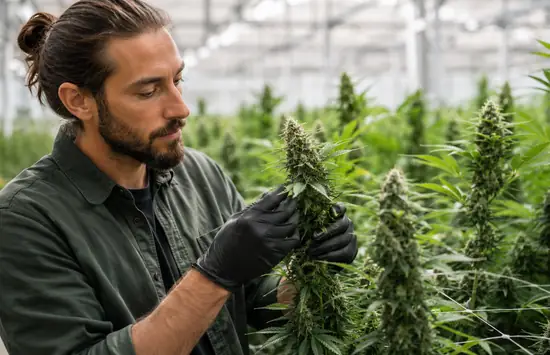
Is Modern Weed Genetically Modified? GMO Myths vs Selective Breeding
Walk into a dispensary today and you'll see buds testing north of 25% THC. Frosted with trichomes, dense, loud on the nose. Plenty of people look at that and assume something happened in a lab that shouldn't have. The question comes up over and over: is weed genetically modified?
Here's the straight answer. The cannabis you can actually buy is not a GMO. The potency, the colors, and the wild flavors all come from selective breeding, the same method humans have used on every crop from corn to apples for thousands of years. Let's break down where the GMO weed myth came from, what's real, and why the difference is worth knowing.
Is weed genetically modified?
No. There is no genetically modified cannabis sold at any dispensary or seed bank on earth. Every strain you've heard of, from Sour Diesel to Wedding Cake, was made the old-fashioned way: crossing two plants and selecting the best of their offspring across many generations.
That holds true even for strains with names that sound like a chemistry set. The “GMO” you spot on a menu has nothing to do with genetic modification, which trips up a lot of people. More on that in a second.
What does GMO actually mean?
A genetically modified organism has had its DNA directly rewritten in a lab, usually by inserting or deleting specific genes. Roundup Ready soybeans and Bt corn are the classic examples. Scientists added a gene the plant never had in nature, giving it a trait it could not have developed on its own.
Selective breeding works nothing like that. You choose two parent plants carrying traits you want, cross them, grow out the seeds, and keep the standouts. Then you do it again. And again. No lab equipment, no foreign DNA, just time and a trained eye for the best plants. It is slow, hands-on, and completely natural.
The two also run on completely different clocks. A lab can edit a gene in a single generation. Breeding a stable new strain the natural way can eat up five years or more of growing, testing, and culling. One is a precise edit to the source code. The other is a long conversation with the plant.
This is exactly where the naming confusion kicks in. One of the most popular strains on dispensary menus is simply called GMO. The letters stand for Garlic, Mushroom, Onion, a nod to the pungent, savory terps it throws off. It's a cross of Chemdawg and Girl Scout Cookies that pushes around 30% THC, and it was built entirely through breeding. Not one gene was spliced. The name just sounds like it came out of a beaker.
Where did the GMO weed myth come from?
Mostly from one viral hoax that refuses to die. In 2015, a satirical website called World News Daily Report published a fake story claiming agriculture giant Monsanto had patented genetically modified cannabis. The post tore across social media, feeding straight into existing fears about big corporations owning the food supply.
The whole thing was invented. Monsanto issued a standing denial and tweeted reminders nearly every year around 4/20 that it had never worked on GMO marijuana. The rumor keeps circulating anyway, partly because a good conspiracy is sticky and partly because it played on real anxieties about who controls cannabis as it goes legal and corporate.
A separate misfire added fuel. Years earlier, a misreported study led some outlets to claim seized samples contained GMO markers, when the actual research found almost none. Bad headlines travel faster than corrections.
Why is modern weed so strong if it's not GMO?
Decades of patient selective breeding. That's the entire answer.
Back in the 1970s, a lot of imported weed sat in the single digits for THC. Today double-digit percentages are standard and top-shelf flower pushes past 30%. Breeders got there through slow, deliberate work:
Phenohunting: popping large batches of seeds and hunting through them for the rare standout plants, called phenotypes.
Crossing: pairing those standouts to stack their best traits into the next generation.
Backcrossing: breeding a plant back into its own lineage to lock a trait in place and make it dependable.
Stabilizing: running the cycle until the seeds reliably grow into the same plant every single time.
A forensic study that examined unusually potent seized cannabis concluded the sky-high THC was the result of breeding selection, not transgenic modification. The researchers specifically looked for the genetic fingerprints a GMO would leave behind and came up empty.
THC is only part of what breeders chase. They also select for terpene profiles that drive flavor and aroma, for bud structure and resin coverage, for mold resistance, for flowering time, and for yield. A single strain can take years of culling before the seeds run true. Growing conditions matter too, since light, nutrients, and climate all shape the final plant, but the genetic ceiling is set in the breeding room.
This is the real work a serious seed bank does every day. Barney's Farm has spent close to 40 years collecting landrace genetics from the Himalayas and beyond, then refining them by hand. LSD is a clean example: a cross of an old-school Skunk with the Afghan landrace Mazar that now tests around 30% THC, all of it earned through crossing and selection. Pineapple Chunk tells the same story, a stable, heavy-yielding Skunk and Cheese cross near 28% THC that took years of phenohunting to lock in. No spliced genes, just decades of picking the best plants and breeding them forward.
Are feminized and autoflowering seeds GMO?
This one confuses people too, and the answer is still no.
Feminized seeds are made by getting a female plant to produce pollen, then using it to pollinate another female. The result is seeds that grow into female plants almost every time. That's controlled pollination, a breeding technique, not genetic engineering.
Autoflowering seeds aren't GMOs either. They get their auto-flowering trait from cannabis ruderalis, a hardy subspecies from northern climates that flowers based on age instead of light schedule. Breeders crossed ruderalis into photoperiod strains the natural way. No genes were edited. The plant just inherited a trait from a wild relative.
Is anyone genetically engineering cannabis at all?
In labs, yes. Just not for the seeds in your jar.
Researchers have used CRISPR, the gene-editing tool, on hemp in controlled studies. One experiment edited a gene and produced albino seedlings as a proof of concept. The bigger goals are tuning cannabinoid ratios, building in disease resistance, and coaxing plants to make rare compounds that are tough to extract otherwise. Interest has picked up in recent years as the tools get cheaper and the cannabis genome gets better mapped.
None of that has reached the shelf. There's no evidence that genetically modified cannabis is being sold to consumers anywhere. The science is early, cannabis genetics are still loosely mapped next to crops like corn and soy, and decades of federal restrictions slowed research to a crawl. Gene-edited cannabis may show up eventually, but it isn't here now, and it won't arrive quietly when it does.
So if someone swears their gummies are made from GMO weed, they're mistaken. The plant behind them was bred, not engineered.
Is GMO weed dangerous?
Since there's no genetically modified cannabis on the market, there's nothing to worry about right now. The buds in dispensaries and the seeds from reputable banks are bred, not engineered, full stop.
The bigger point is that the panic usually aims at the wrong target. People picture some Frankenstein plant when the real story is far less dramatic: skilled breeders crossing strains and waiting out the results. If gene-edited cannabis ever does arrive, it will be labeled, regulated, and studied like any other engineered crop. Until that day, the GMO scare is pointed at a plant that doesn't exist yet.
How to spot the difference, and why it matters
You can't eyeball a GMO. But you can get smart about what you're actually buying.
Read the lineage. Every legit strain has parents. Chemdawg crossed with GSC. Blueberry crossed with Haze. A documented family tree means the plant was bred.
Ignore the scary names. GMO, Gorilla Glue, Alien Tech. That's marketing language, not a lab report.
Trust stable genetics. The real mark of quality is consistency. Good seeds grow into the plant the breeder promised, batch after batch. That reliability comes from generations of selection.
Modern cannabis is potent because breeders are exceptionally good at their craft, not because anyone rewired the plant's DNA. Next time someone tells you your weed is a science experiment, hit them with the truth: it's something older and frankly more impressive, a few thousand years of people finding the best plants and doing it all over again.
Barney's Farm has been developing premium cannabis genetics since the 1980s, with over 40 Cannabis Cup wins. Explore our full seed catalog and find strains bred for every climate and skill level.