
 Autoflower Seeds
 Feminized Seeds
 New Releases
 USA Cannabis Seeds
 High THC Strains
 High Yield Cannabis Strains
 Precision F1 Hybrids
 Washing Strains
 Cup Winning Cannabis Seeds
 Chill Out Cannabis Strains
 Amsterdam Cannabis Seeds Classics
 Best Taste & Aroma Cannabis Seeds
 Regular Seeds
 Merchandise
 Merchandise
 Blog
Blog Contact Us
 Wholesale Login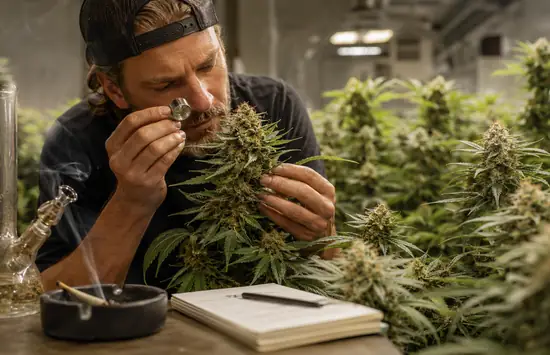
Phenohunting Explained: How Breeders Find the One Plant in Ten Thousand
Open a pack of ten seeds from the same strain. Every one of those seeds is a genetic gamble. Most will grow into something fine. One might be average. And one, if you're lucky, will be the freak. The plant that smells louder, hits harder, and stacks bigger than its siblings. That keeper is what serious breeders spend months hunting for, sometimes through thousands of plants at a time, sometimes through tens of thousands. The process is called phenohunting, and it's the reason your favorite strain tastes the way it does.
This is how cannabis genetics actually get refined. Not in a sterile lab spitting out cookie-cutter clones, but in big rooms full of plants, where someone with thirty years of experience walks the rows with a magnifier and a notebook, looking for the one.
What does phenohunting mean in cannabis breeding?
Every plant has two layers of identity. The genotype is the genetic code locked in the seed. The phenotype is the set of observable characteristics of an organism, produced by the interaction of its genotype with the environment. Two seeds from the same parents share most of their genetics but not all of it, and they never grow in identical conditions. Different gene combinations express differently. The result is sibling plants that can look, smell, and smoke nothing like each other.
Phenohunting is the work of growing out a big population of seeds, evaluating every plant against a set of standards, and selecting the one that delivers on every box. That one plant becomes the source of every gram of that cultivar that ever gets sold, smoked, or rolled into a joint. The losing plants get killed. The winner gets kept alive forever through cloning.
It's a numbers game, and it's brutal.
How breeders find the one plant in ten thousand
The math is ugly. A breeder running a serious hunt might start with a thousand seeds for a new line, sometimes more. Of those, maybe two hundred plants show real promise during veg. By flowering, that pool shrinks to twenty or thirty. By harvest and cure, you might be down to three candidates. Then you smoke them, you grow second runs, you watch how they react under stress, and the field narrows again. Most hunts end with one or two keepers. Some end with none.
At Barney's Farm we've been running this process since the late 1980s, when the founders walked back from the Himalayas with bags of landrace seed and started cracking them out behind the Amsterdam coffeeshop. The first hunts produced our original Pineapple line, the Critical-leaning indicas, and the Skunk crosses that built the catalogue. Forty Cannabis Cup wins later, the workflow hasn't changed that much. We pop the seeds, we walk the rows, we keep notes on every plant, and we kill anything that isn't pulling its weight. The plant that ends up on a shelf with a name on it was the one survivor of a hunt that started with hundreds.
The standard isn't "good." The standard is the absolute best version of what that cross could possibly produce.
What traits do cannabis breeders look for in a phenohunt?
Resin production gets checked first. The glandular trichomes on the flower are where cannabinoids and terpenes are made and stored, and modern cultivars produce trichomes that are physically larger than their landrace ancestors and contain more secretory cells, with the increased phytocannabinoid and terpene concentrations directly reflected in those bigger glands. More resin usually means more potency and more flavor, so a heavy froster gets flagged immediately.
Aroma is next. The hunter sticks a finger into a leaf joint, rubs it, and smells. Then they squeeze a developing bud and smell again. They're checking for terpene complexity, intensity, and uniqueness. A plant that smells like every other plant in the room is not a keeper. The freak smells like nothing else.
Structure matters too. Internode spacing, branch strength, bud-to-leaf ratio, how the plant carries its weight in week eight. A great pheno produces dense flowers on strong stems and finishes evenly from top to bottom. The bad pheno is leafy, airy, leans on its neighbors, and finishes in patches.
Flowering time, mold resistance, stretch under different light cycles, response to topping and training, terpene retention after cure. Every plant gets scored on all of it. The keeper has to hit every category.
Why does every seed in your pack look different?
If you've ever grown two seeds of the same strain side by side and ended up with two completely different plants, you've watched genetics work in real time. Cannabis is what biologists call highly heterozygous, meaning the genome carries a huge amount of variation between maternal and paternal chromosome copies. In a genome-wide association study of 176 drug-type cannabis accessions, researchers identified 18 genetic markers significantly associated with agronomic and morphological traits, several of which exert substantial phenotypic impact on the plant. Translation: small changes in the DNA produce visible, measurable changes in the plant.
This is why F1 seeds, the first cross between two distinct parents, tend to look more uniform, while F2 and beyond start throwing wider phenotype ranges. It's also why phenohunting matters. A "stable" strain is one that has been hunted and selected through enough generations that most seeds express the same general traits. An unstable line behaves like a deck of cards every time you crack a pack.
How does a phenotype become a mother plant?
Once a breeder finds the keeper, the next move is to never let it die. The plant gets put into permanent vegetative state under an 18-hour light cycle, and clones get taken from it. Those clones become the production stock. The original plant is called the mother, and the best ones get kept alive for years, sometimes decades.
The famous OG Kush cut that took over American cannabis in the 1990s and 2000s? Same plant, cloned thousands of times. Chemdawg 91? Same plant. GG#4, Wedding Cake, Zkittlez cuts? All single phenos kept alive in a mother room somewhere, dripped out to growers, copied and recopied. The genetic material of an entire commercial cannabis market traces back to a handful of selected plants that some hunter decided were worth saving.
This is also why breeders are protective. Lose the mother in a power outage or a pest outbreak and you can lose the strain entirely. The seeds will give you something close but never identical. The pheno is the pheno.
How did phenohunting create the cannabis we smoke today?
Pull up any strain menu in a Denver, LA, or Detroit dispensary and almost everything on it can be traced back through phenohunts. The competitive pressure that drove modern hunting started in Amsterdam in the late 1980s, when High Times launched the Cannabis Cup in November 1988 as a festival where judges sample and vote for their favorite cannabis varieties, with trophies awarded to the overall winners. The first cup went to Skunk #1, and within a few years every serious seed bank in the city was running hunts trying to outdo the last winner.
The 1990s minted a generation of phenos that are still on the menu. White Widow clinched the 1995 Cup for Green House and reset expectations for resin production, and by the late 1990s Super Silver Haze dominated the sativa category at the same event. Each of those wins was a pheno hunt that paid off. Each cultivar got copied, crossed, and re-hunted until you ended up with the modern menu.
Our own Critical Kush sits in that lineage. It started as a hunt through Critical Mass and OG Kush seedstock, looking for the indica-leaning plant that delivered the highest yield without losing the OG terpene profile. The keeper we found is still being cloned out today.
Why phenohunting actually matters to you
When you smoke a great strain, you're not smoking a recipe. You're smoking the survivor of a tournament. One plant that beat hundreds or thousands of siblings, got kept alive by someone who knew what to look for, and got copied enough times to reach your jar. That's what phenohunting is.
It's also why genetics from breeders with thirty or forty years of hunting experience hit different. Our Pineapple Chunk didn't get its terpene profile by accident. Someone walked rows for months, killed most of the field, and saved the one plant worth keeping. Then we did it again the next generation. And again. That work is what's in the seed when you pop it.
Barney's Farm has been developing premium cannabis genetics since the 1980s, with over 40 Cannabis Cup wins. Explore our full cannabis seed catalog and find strains bred for every climate and skill level.