
 Autoflower Seeds
 Feminized Seeds
 New Releases
 USA Cannabis Seeds
 High THC Strains
 High Yield Cannabis Strains
 Precision F1 Hybrids
 Washing Strains
 Cup Winning Cannabis Seeds
 Chill Out Cannabis Strains
 Amsterdam Cannabis Seeds Classics
 Best Taste & Aroma Cannabis Seeds
 Regular Seeds
 Merchandise
 Merchandise
 Blog
Blog Contact Us
 Wholesale Login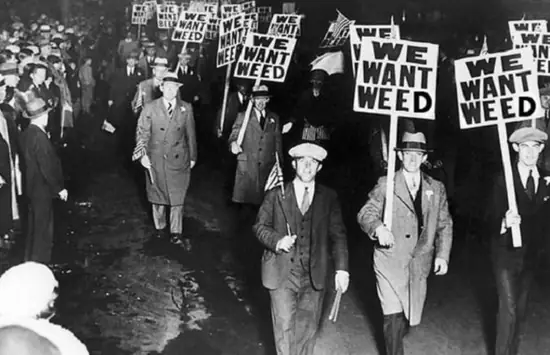
The 1937 Marihuana Tax Act: How Cannabis Became Illegal in America
For most of American history, cannabis was legal. It grew on farms, sat on pharmacy shelves, and turned up in tinctures your great-great-grandparents could buy without anyone blinking. Then one law in 1937 flipped the whole thing on its head. There was no medical emergency. No wave of overdoses. No new science. Just a tax form, a bureaucrat with something to prove, and a newspaper empire happy to print whatever moved copies. This is the story of how weed went from common cash crop to federal contraband, and why a law that died decades ago still shapes life in the United States today.
So why is weed illegal in the United States?
The honest answer irritates a lot of people: cannabis was never banned because anyone proved it was dangerous. For most of the country's history it was an ordinary crop and an ordinary medicine. Farmers grew hemp for rope, sailcloth, and paper. Pharmacies stocked cannabis extracts and sold them over the counter. The plant was useful, common, and pretty much everywhere, which makes its sudden fall from grace all the stranger. The first nationwide law built specifically to choke it off did not arrive until 1937. Before that, the rules were a loose patchwork of state laws, and Washington had mostly stayed out of the question entirely. So what actually changed in 1937 was not the plant or the people smoking it. It was the politics that had wrapped around both.
What did the 1937 Marihuana Tax Act actually do?
Here is the clever, ugly trick at the center of it. Congress did not believe it had the power to flat-out ban a plant, so it reached for a backdoor: taxes. President Franklin D. Roosevelt signed the Marihuana Tax Act into law in 1937, and it took effect that October. On paper, it was a revenue measure. In practice, it was a cage. Anyone who wanted to deal in cannabis had to register with the government, pay a special tax, and obtain stamps that the authorities had almost no intention of handing out. Skip a step and you were looking at steep fines or prison time.
The knock-on effects were immediate and brutal. Doctors stopped prescribing cannabis rather than wrestle with the paperwork and the legal risk. Researchers walked away from a plant that had been studied openly for a century. The American hemp industry, which had nothing to do with getting anyone high, got taxed into oblivion almost overnight. The first arrests landed within a day of the law going live, and the people swept up were exactly the kind of small-time users and sellers Anslinger had spent years vilifying. The tax was never really about collecting money. It was about making the plant impossible to touch without breaking the law.
Who was Harry Anslinger?
Every prohibition needs a true believer, and cannabis got Harry J. Anslinger. He took over the brand-new Federal Bureau of Narcotics in 1930 and ran it for 32 years, outlasting five presidents. Here is the strange part. Early on, Anslinger did not think cannabis was a serious threat at all. He once brushed off the idea that the plant drove people to violence as an absurd fallacy. Then national alcohol prohibition ended, his young agency suddenly needed a reason to exist, and Anslinger went hunting for a new enemy. He found it in a plant he had previously shrugged at, and he spent the rest of his career making sure the country feared it as much as he now claimed to.
What were the Gore Files?
To sell a panic, you need monsters, and Anslinger manufactured them. He assembled a collection of gruesome crime stories he pinned on marijuana, a stash he called the Gore Files. His favorite was the case of Victor Licata, a Florida teenager who killed his family with an axe. Anslinger repeated that story to anyone who would listen, Congress included. The problem was that Licata had a long, documented history of severe mental illness that had nothing to do with cannabis, and researchers later found that 198 of the roughly 200 cases in the files were fabricated or wrongly blamed on the plant.
The facts did not slow him down. Newspaper baron William Randolph Hearst splashed the stories across his national chain, and lurid headlines did the rest of the work. By the time the 1936 film Reefer Madness turned the hysteria into popcorn entertainment, the lie had already won. People were terrified of a plant most of them had never knowingly encountered.
Was cannabis prohibition racist?
This is the part the history books skipped for decades, and it is not subtle. Anslinger's entire campaign leaned on race. He tied cannabis to Black Americans, to Mexican immigrants, and to jazz musicians, and his public statements were openly bigoted. His testimony to Congress was riddled with racist claims dressed up as expertise. Even the word marihuana was a weapon. Most Americans knew the plant as cannabis or Indian hemp. Reaching for a Spanish-sounding term made it feel foreign and threatening, which was exactly the point.
The fear Anslinger sold was never about chemistry or public health. It was about who was using the plant, and what a nervous white establishment decided that use meant. Strip away the propaganda and the law looks less like drug policy and more like a tool for controlling the people the country was already eager to control.
What happened to the Marihuana Tax Act?
The law stood for more than three decades before it finally cracked. Then Timothy Leary, the psychedelic evangelist, got arrested for cannabis possession and fought back. In 1969 the Supreme Court struck the act down in Leary v. United States, ruling that forcing someone to buy a tax stamp for an illegal substance effectively made them confess to a crime, which violated the Fifth Amendment. That sounds like a win. It was not. Congress regrouped fast, and in 1970 it passed the Controlled Substances Act, dropping cannabis into Schedule I alongside heroin and labeling it as having no accepted medical use. Prohibition did not end that day. It just changed clothes and kept walking.
Why does a law from 1937 still matter?
Because the damage compounded for almost a century, and it landed exactly where Anslinger aimed it. Generations of aggressive enforcement fell hardest on the same communities his propaganda had targeted from the start. Even now, with legal dispensaries operating across much of the country, a Black person is roughly 3.6 times more likely to be arrested for marijuana possession than a white person, despite both groups using it at similar rates. Legalization handed the plant a pardon in a lot of states. The bill for how and why it was banned in the first place is still being paid off.
That bill is not abstract. A possession charge can follow someone for life, blocking jobs, housing, and loans long after the weed itself stopped being illegal next door. States are only now starting to clear old records and reinvest in the neighborhoods that absorbed the worst of enforcement. The plant moved faster than the paperwork, and millions of people are still waiting for the system to catch up to the culture.
Where Barney's Farm fits into all this
We have spent nearly four decades working on the other side of that history. Barney's Farm started in Amsterdam in 1986, in a country that gave cannabis a little room to breathe while the United States was still locking people up over it. Our founder, Derry, spent years chasing landrace genetics across the Himalayas, Afghanistan, Africa, and Central America, hauling home the seeds that prohibition had tried to erase. More than 40 Cannabis Cup wins later, those trips still live inside our catalog.
Take Acapulco Gold. The marihuana scare of the 1930s was aimed squarely at Mexican heritage, and Acapulco Gold is a living piece of that heritage, a golden, sativa-forward classic built on Central American genetics that outlasted everything Anslinger threw at it. Our Acapulco Gold is the modern version, refined for stability but loyal to the original.
Then there is Skunk #1. When American breeders could not work out in the open, a small underground collective in 1970s California treated cannabis like a serious agricultural science anyway, crossing Afghan, Acapulco Gold, and Colombian Gold into the strain that rewired the entire industry. Skunk #1 carries that exact lineage forward, and nearly every modern hybrid you have heard of owes it a quiet debt.
The Bottom Line
That is the revenge running underneath this whole story. Anslinger wanted the plant gone and the people who grew it forgotten. Instead the genetics outlived him, the breeders kept working in the shadows until the laws caught up, and the seeds he tried to stamp out now ship around the world. Prohibition wrote the law. The growers wrote the comeback.
Barney’s Farm has been developing premium cannabis genetics since 1986, with more than 40 Cannabis Cup wins. Explore our full cannabis seed catalog and find the genetics that fit how you actually medicate.