
 Autoflower Seeds
 Feminized Seeds
 New Releases
 USA Cannabis Seeds
 High THC Strains
 High Yield Cannabis Strains
 Precision F1 Hybrids
 Washing Strains
 Cup Winning Cannabis Seeds
 Chill Out Cannabis Strains
 Amsterdam Cannabis Seeds Classics
 Best Taste & Aroma Cannabis Seeds
 Regular Seeds
 Merchandise
 Merchandise
 Blog
Blog Contact Us
 Wholesale Login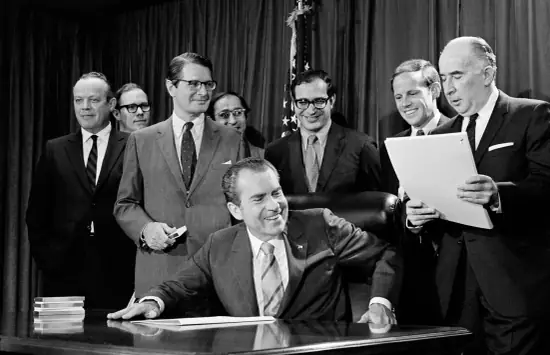
The 1970 Controlled Substances Act: How Cannabis Got Placed With Heroin
Cannabis sits in Schedule I of federal law. So does heroin. Cocaine and methamphetamine sit one rung lower, in Schedule II, the tier the government reserves for drugs it admits have real medical uses. Read that again. A plant humans have grown for thousands of years got filed above two of the hardest drugs on earth, and it has stayed parked there for over five decades.
That ranking was not an accident, and it was not the result of some careful lab study. It was a political decision made in 1970, and the story of how it happened explains why federal weed law still feels so broken in 2026.
What Is the 1970 Controlled Substances Act?
The Controlled Substances Act was signed into law in October 1970 and sorted every federally regulated drug into one of five schedules. It arrived as part of a bigger package, the Comprehensive Drug Abuse Prevention and Control Act, and it handed enforcement power to the federal government in a way no earlier drug law had.
Schedule I sits at the top of the pyramid. To land there, a substance has to clear three bars: no accepted medical use, a high potential for abuse, and no accepted safety even under a doctor's supervision. Schedules II through V step down from there. Schedule V holds mild stuff like cough preparations with tiny amounts of codeine. The whole thing was sold as a clean, rational filing cabinet for drugs. The fight has always been about which drawer cannabis belongs in.
How Was Cannabis Treated Before 1970?
The 1970 law did not invent cannabis prohibition. It rebuilt it with cleaner paperwork. Back in 1937 the Marihuana Tax Act had already pushed the plant to the edge of legality, driven hard by Harry Anslinger, the first head of the Federal Bureau of Narcotics, who built a career on lurid stories about what cannabis supposedly did to people. By the time Nixon took office, most states had their own bans on the books and the federal mood was already set. The Controlled Substances Act took that messy, decades-old hostility and handed it a tidy bureaucratic structure, with Schedule I as the harshest setting on the dial.
Why Is Weed a Schedule I Drug?
Cannabis went straight into the top drawer, shoulder to shoulder with heroin and LSD. Meanwhile cocaine and meth, drugs with accepted medical applications, landed in Schedule II. On paper that means the federal government has spent 55 years claiming weed is more dangerous and less useful than cocaine.
That top-shelf status carried real teeth. Schedule I drugs sit under the heaviest research restrictions in the country, which set up a brutal catch 22. Cannabis got branded medically useless, and the same classification then made it almost impossible for scientists to run the studies that might prove otherwise. The government locked the door, then pointed at the locked door as proof the plant had nothing to offer.
Congress checked the Schedule I boxes for cannabis in 1970 with almost no scientific support. The recommendation came from a health official who said in writing that the placement should be treated as temporary while researchers actually studied the plant. Lawmakers knew they were guessing. They built in a commission to get a real answer and correct the record later. That commission came back with an answer nobody in the White House wanted to hear.
What Did the Shafer Commission Recommend?
Nixon set up the National Commission on Marihuana and Drug Abuse and put Republican governor Raymond Shafer in charge. He expected ammunition. Accounts from the era show him leaning hard on Shafer for a brutal anti-cannabis verdict, the kind that would justify the crackdown he already had in motion.
He did not get it. The commission's 1972 report recommended decriminalizing possession of small amounts for personal use, and it argued that hammering cannabis users drained energy away from the real fight against heroin. Nixon tossed the report aside and would not accept it publicly. He also brushed off similar findings from a Canadian commission and a British report that had reached the same conclusion. Cannabis stayed locked in Schedule I, where it remains today.
Was the War on Drugs Really About Drugs?
This is where the official version comes apart. Nixon had already fired the opening shots, shutting down the Mexican border in 1969 with Operation Intercept and declaring drug abuse public enemy number one in 1971. The scheduling was the legal backbone for all of it.
Years later, the motive got spelled out. In a 1994 interview that surfaced in Harper's two decades on, Nixon's domestic policy chief John Ehrlichman admitted the drug war was designed to go after the antiwar left and Black communities. The strategy he described was simple and cynical: link hippies to marijuana, link Black Americans to heroin, then criminalize both heavily so the government could raid homes, break up meetings, and trash both groups on the nightly news. He flatly said they knew they were lying about the drugs.
So the science was never driving the bus. Cannabis did not earn its Schedule I status through evidence. It got there because a plant made a convenient target for a political machine.
What Barney's Farm Knows About Surviving Prohibition
Governments can ban a plant. Killing its genetics is a whole different job, and on that front prohibition lost.
While the United States was slamming borders shut and locking up growers, the seeds kept moving quietly around the world. Barney's Farm opened in Amsterdam in 1986 with a mission that ran directly against the grain of the era: track down landrace genetics in the remote places they had grown wild for centuries and preserve them before prohibition and careless crossbreeding erased them for good. Our founder Derry spent years on sourcing trips through mountain ranges and valleys most seed banks never set foot in, hauling back the raw material that four decades of breeding and over 40 Cannabis Cup wins were built on.
Look at Acapulco Gold, a legend pulled from the Mexican sativa heritage that Nixon's border raids were aimed squarely at. The government tried to choke off exactly this lineage at the source in 1969. Decades later it lives on as stable, feminized seed, golden buds and a bright cerebral high that growers can put in the ground legally in much of the country. The crackdown wanted these genetics gone. They got preserved, sharpened, and passed to a new generation instead.
That is what the scheduling fight has always gotten wrong. A seed does not care about a senator's vote. It carries on doing what cannabis has done for thousands of years, with or without permission. There is something fitting about a seed bank doing quietly, with patience and careful record keeping, what no protest march ever could: keeping the actual plant alive and getting better while the politicians argued in circles.
Is Cannabis Still Schedule I in 2026?
The wall is finally cracking, slowly. In 2026 the Justice Department moved FDA-approved and state-licensed medical cannabis down to Schedule III, the first genuine loosening of the framework built in 1970. A federal hearing to weigh rescheduling cannabis more broadly is set for late June 2026, the next step in a review that has dragged on for years and drew tens of thousands of public comments.
Read the fine print before you celebrate. Recreational cannabis is still sitting in Schedule I until that wider process finishes, which keeps most of the legal market federally illegal for the moment. A dispensary operating in full compliance with its state can still be a federal criminal, depending on which side of the medical line it falls. After 55 years, the machine assembled in 1970 is finally inching forward, at exactly the pace you would expect from a system that was never built to admit it was wrong.
The Genetics Outlasted the Law
Strip the politics away and one hard fact is left standing. A plant got branded as dangerous as heroin to win elections, and millions of people got dragged through courtrooms and cells because of it. Evidence had nothing to do with the original decision.
The genetics shrugged it all off. A strain like LSD, a Skunk and Mazar cross that grabbed a Cannabis Cup in 2008, still carries the kind of wild, potent lineage the 1970 law tried to stamp out, now bottled into seed you can actually grow. Schedule I has lasted 55 years and counting. The plants it was built to erase are still here, stronger, cleaner, and better documented than they have ever been.
That is the real history of cannabis scheduling. The law aged like milk. The weed aged like a champion.
Barney’s Farm has been developing premium cannabis genetics since 1986, with more than 40 Cannabis Cup wins. Explore our full cannabis seed catalog and find the genetics that fit how you actually medicate.