
 Autoflower Seeds
 Feminized Seeds
 New Releases
 USA Cannabis Seeds
 High THC Strains
 High Yield Cannabis Strains
 Precision F1 Hybrids
 Washing Strains
 Cup Winning Cannabis Seeds
 Chill Out Cannabis Strains
 Amsterdam Cannabis Seeds Classics
 Best Taste & Aroma Cannabis Seeds
 Regular Seeds
 Merchandise
 Merchandise
 Blog
Blog Contact Us
 Wholesale Login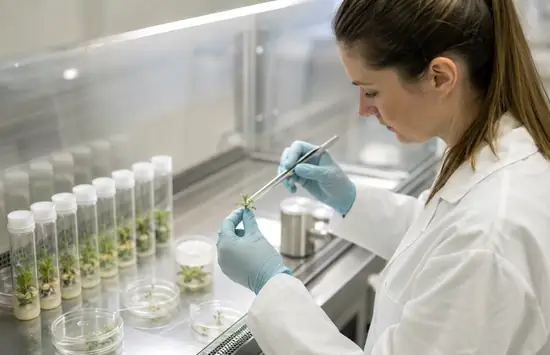
Tissue Culture Cannabis: How Elite Genetics Are Preserved in Labs
A prize cutting can vanish in a single bad week. A power outage, a spider mite outbreak, a viroid nobody spotted in time, and a genetic line that took years to dial in is gone. Growers have lost legendary cuts this way for decades. The fix that commercial cannabis has landed on is not a bigger mother room. It is a glass jar the size of a shot glass, sitting on a lab shelf, holding a flagship strain in suspended animation.
That technique is tissue culture, and it is quietly changing how the best genetics survive.
What is cannabis tissue culture?
Tissue culture, also called micropropagation, grows whole plants from tiny pieces of plant tissue inside a sterile container. A technician takes a sliver of a leaf, a node, or the growing tip of a shoot, sterilizes the surface, and places it on a nutrient gel loaded with sugars, minerals, and plant hormones. Under controlled light and temperature, that fragment multiplies into shoots, then roots, then full plantlets. The Latin term for the method is in vitro, meaning in glass, which sums up the whole idea.
None of this is new to agriculture. The method traces back to work by Cornell botanist Frederick Campion Steward in the late 1950s, and the orchids, bananas, and strawberries on supermarket shelves have been propagated this way for generations. Cannabis arrived late to the party, mostly because prohibition kept it out of serious plant science labs. Legal markets have since caught up, and tissue culture has moved from a research curiosity to a standard tool for serious breeders.
How does the micropropagation process actually work?
Every micropropagation run follows the same four stages, whether the plant is a banana or a Cannabis Cup winner.
Initiation. A small piece of tissue, the explant, is cut from a chosen plant, washed, and surface-sterilized so no bacteria or fungi ride along. It then goes onto sterile gel to establish.
Multiplication. Hormones in the gel push the explant to throw out multiple shoots. Each shoot can be divided and re-cultured, so one sample turns into many, then many more.
Rooting. The hormone balance is switched to coax roots from the young shoots, turning them into complete little plants.
Acclimatization. The plantlets are slowly hardened off and moved out of the jar into soil or another growing medium, where they learn to handle real-world humidity and light.
Contamination is the constant enemy through all of it. A jar of sugary gel is a five-star buffet for mold and bacteria, so the work happens under a laminar flow hood that blows filtered air across a clean bench. One slip in sterility and the whole batch is lost.
Tissue culture vs clones: what is the real difference?
Standard cloning takes a cutting from a mother plant, dips it in rooting hormone, and waits for roots. It works, it is cheap, and almost every grower has done it. The catch is that a clone is a perfect copy of whatever the mother is carrying. If the mother hides a virus, a fungus, or a viroid, every cutting inherits it.
Tissue culture changes the math in three ways:
Scale. A single mother yields a handful of cuttings at a time. One tissue sample can be divided again and again into hundreds of plantlets in a fraction of the floor space.
Storage. A mother room burns square footage, power, and labor every single day. A library of cultures sits quietly in jars and can hold genetics for months between transfers.
Cleanliness. This is the big one. By culturing the meristem, the microscopic growing tip where infections often have not reached yet, labs can pull a clean version of a plant out of an infected one.
Clones keep a strain alive. Tissue culture keeps it alive and clean, which is a separate job entirely.
Why do clean cannabis genetics matter?
For most of cannabis history, clean genetics was a vague idea. Then hop latent viroid showed up and made it brutally concrete.
Hop latent viroid, usually shortened to HLVd, is a scrap of infectious RNA so small it barely qualifies as a pathogen. It was first confirmed in California cannabis in 2019, and has since spread across Oregon, Washington, and Canada. The cruel part is how quiet it is. Infected plants often look healthy for weeks while the viroid passes along pruning blades, gloves, and shared water. By the time you see stunted growth, brittle stems, and thin, low-resin buds, the damage is already locked in.
The scale is real. In one multi-year survey, roughly a quarter of cannabis samples from licensed Canadian facilities tested positive for the viroid. Because it rides inside healthy-looking clones, a single infected cutting can seed an entire grow. That is why clean cannabis genetics stopped being a marketing phrase and turned into a survival requirement.
How are elite genetics preserved in a lab?
Preserving a strain comes down to two jobs: get it clean, then keep it that way.
The cleaning step usually relies on meristem culture, sometimes paired with heat. The growing tip of a shoot divides so fast that viroids and viruses often cannot keep up, so tissue taken from that exact spot can come back clean. In a 2025 study, researchers cleared HLVd from five of thirteen cannabis cultivars using meristem tip culture combined with thermotherapy, and the plants stayed clean for months afterward.
Once a line is verified clean, the lab can do three things with it:
Bank it. Cultures are kept in cool, low-light storage and refreshed on a schedule, acting as a backup no mite or mold can wipe out overnight.
Multiply it on demand. When clean stock is needed for production, technicians scale it up from the stored cultures instead of hunting for an uninfected mother.
Keep it true to type. Because every plantlet comes from the same verified tissue, the cannabinoid and terpene profile stays consistent batch after batch.
The payoff is a strain that performs the same way this year as it did three years ago, which is exactly what a breeder protecting a reputation needs.
Barney's Farm and the genetics worth protecting
Genetics are only worth preserving if they were special to begin with. Barney's Farm has spent close to forty years building a library that earns the effort, with more than forty Cannabis Cup wins stacked up behind it.
The story starts in the Himalayas, where founder Derry collected landrace genetics from farmers who had been selecting the same lines for generations. Those landraces still run through the catalog. Critical Kush is a clear example, a heavy indica built on Critical Mass crossed with OG Kush, carrying Afghani, Hindu Kush, and Skunk #1 deep in its bloodline. It is the kind of stabilized, old-school genetics that breeders fight to keep intact.
The other side of the catalog shows where modern breeding goes once the foundation is solid. Blue Gelato 41 fuses Blueberry, Thin Mint Girl Scout Cookies, and Sunset Sherbet into a resin-soaked hybrid pushing 28 percent THC. Hitting that mark takes parent lines that behave predictably every single run, which only happens when the underlying genetics are locked down and protected.
That stability is also why seeds matter. Every Barney's Farm strain goes through years of selection and backcrossing before release, so the numbers on the page hold up in the tent. For the full picture on buying seeds in the current legal climate, our guide on what changed for cannabis seeds in 2026 breaks it down.
What does tissue culture mean for home growers?
You do not need a laminar flow hood to benefit from any of this. The lesson for everyday growers is simpler than the lab work behind it.
Most home grows pick up HLVd from a borrowed or bought clone, not from seed. Starting from quality seed sidesteps the single biggest way the viroid travels, because a seed does not carry a mother plant's hidden infections the way a cutting does. From there, basic hygiene handles most of the risk. Sterilize your blades between plants, never run the same tool across a sick plant and a healthy one, and keep your water clean.
Tissue culture is the industrial-strength version of a habit every grower should already have, which is treating clean genetics as the foundation everything else is built on. The labs do it with meristems and gel. You can do it with good seed and a bottle of isopropyl. Either way, the genetics are the asset. Protect them.
Barney's Farm has been developing premium cannabis genetics since the 1980s, with over 40 Cannabis Cup wins. Explore our full seed catalog and find strains bred for every climate and skill level.