
 Autoflower Seeds
 Feminized Seeds
 New Releases
 USA Cannabis Seeds
 High THC Strains
 High Yield Cannabis Strains
 Precision F1 Hybrids
 Washing Strains
 Cup Winning Cannabis Seeds
 Chill Out Cannabis Strains
 Amsterdam Cannabis Seeds Classics
 Best Taste & Aroma Cannabis Seeds
 Regular Seeds
 Merchandise
 Merchandise
 Blog
Blog Contact Us
 Wholesale Login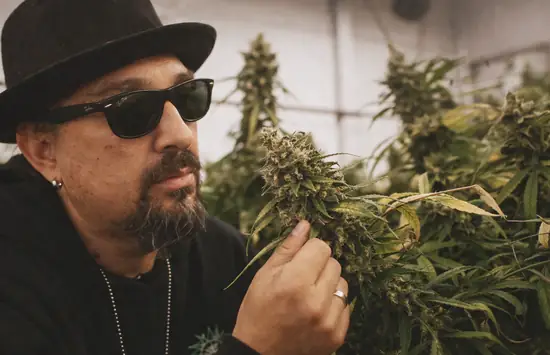
What Does “OG” Actually Mean in Cannabis?
Walk into any dispensary in California, Colorado, New York, or Michigan and you will see OG everywhere. OG Kush, Tahoe OG, Skywalker OG, Fire OG, SFV OG, Larry OG, Insane OG. The two letters get stamped on jars, vape carts, pre-rolls, and shake bags like a quality seal nobody can quite explain. Ask ten cannabis people what OG stands for and you will get ten different answers, half of them confidently wrong.
So let’s actually figure this out. What does “OG” really mean, where did it come from, and why has it stuck around for thirty years? The answer involves Florida, a Hollywood apartment, the Hindu Kush mountains, a 1991 hip-hop album, and a Cuban-American rapper with a thing for blunts the size of bananas.
Where does “OG” actually come from?
Before “OG” was a weed thing, it was a hip-hop thing. The two letters started circulating in Southern California gang slang in the 1980s as a respect tag for older, established members. The term went mainstream when Ice-T dropped his fourth studio album, O.G. Original Gangster, on May 14, 1991, certified gold by the RIAA that July. After that, “OG” was officially in the cultural water supply.
It also leaked straight into the LA cannabis scene, where it lived alongside the people putting weed in songs. Ice-T, Snoop, Dr. Dre, and Cypress Hill were all building a sound around West Coast street life, and weed was woven through every bar of it. Cypress Hill in particular leaned all the way in. All of the group members advocate for medical and recreational use of cannabis in the United States, and in 2019 Cypress Hill became the first hip-hop group to have a star on the Hollywood Walk of Fame. When two letters from gang vocabulary met two grams of premium California flower, the timing was perfect.
The OG Kush origin story
The strain that made “OG” a cannabis term was OG Kush. The accepted origin story goes like this: a Florida grower named Matt “Bubba” Berger started growing a unique plant in the early 1990s, possibly a cross of Chemdawg, Lemon Thai, and a Hindu Kush variety, possibly something else entirely. The genetics were murky. The smell was not.
In 1996 Berger flew his cuttings out to Los Angeles and linked up with grower Josh Del Rosso, known as Josh D. They set up in a Hollywood apartment and started running the plant indoors. Most of Berger’s cuttings died in transit. The one that survived became the OG Kush mother plant that every “OG” labeled strain on the market today traces back to.
Demand exploded. By the late 90s and early 2000s, OG Kush was selling in LA at prices that sound made up: eight thousand dollars a pound. Bubba and Josh added “OG” to the name partly to separate their cut from the dozens of fake “Kush” plants that flooded the market once people realized money was on the table. Whatever the letters technically stood for, they meant authenticity. Get the OG. Don’t accept the imitation.
So what does the “OG” part stand for?
Here is where it gets messy, because there is no single answer. There are five competing theories, and each has supporters who will argue about it until last call.
Original Gangster. The most famous theory, fueled by hip-hop. Cypress Hill’s crew is often credited with pinning “Original Gangsta” to the strain, calling it the OG of all the kushes coming through LA. This version got picked up by Amsterdam seedbank DNA Genetics and became the dominant story for two decades.
Ocean Grown. A grower allegedly told someone the buds tasted like they came from the mountains. He shot back that the plant was grown indoors near the California coast. Ocean grown. The name stuck. This one fits the SoCal vibe but has the least hard evidence behind it.
Original Grower. The Northern California version, tied to the Emerald Triangle growers who smuggled Afghan landrace seeds into the US in the 70s. Some old-school cultivators still swear this is the real one.
OverGrown.com. A long-dead cannabis forum from the early 2000s that some people credit. The math does not really work, since the term predates the site.
Original. The plainest answer, and according to Josh D himself, the correct one. He has said in interviews that he and Bubba added “OG” to mean original. As more growers tried to copy their kush, the OG label was their way of marking the genuine cut. Everyone else read more into it.
So which is it? Pick one. Most people will not check.
What about the “Kush” part?
The “Kush” half is at least geographically real. The Hindu Kush is an 800-kilometre-long mountain range stretching from central and eastern Afghanistan into northwestern Pakistan and far southeastern Tajikistan, with the highest point being Tirich Mir at 7,708 metres in the Chitral District of Khyber Pakhtunkhwa, Pakistan. Cannabis has been cultivated in those valleys for centuries, producing short, dense, resin-coated indica plants that local farmers turn into hashish.
In the 1960s and 70s, Western travelers on what was called the Hippie Trail brought seeds back from Afghanistan, Pakistan, and Nepal. Those seeds became the genetic backbone of pure indica strains in California. “Kush” started as a real geographical term and ended up as cannabis shorthand. By the time OG Kush appeared in the 90s, “kush” was already loaded with meaning.
Why “OG” stuck and spread like crazy
OG Kush did not become famous on potency alone. It got pushed into culture by people with microphones. B-Real of Cypress Hill got the cut early through the underground LA grower network and started shouting it out. Snoop Dogg, Wiz Khalifa, and the entire West Coast rap circuit followed. By the mid-2000s, OG was basically a hip-hop sponsorship.
B-Real has spent decades turning that connection into actual cannabis business. He owns the cannabis brand Dr. Greenthumb, named after a Cypress Hill song, and has built it into a working operation alongside Cypress Hill’s continued music output. Barney’s Farm went straight to the source on this one. Our Insane OG is a direct collaboration with B-Real, blending OG Kush, Bubba Kush, and Granddaddy Purple into a 32% THC indica-dominant hybrid that lives up to the name. Old-school terps, gassy nose, hard relax. Built by people who actually were there in the 90s when the OG conversation was happening in real time.
The OG family also exploded genetically. OG Kush is the parent or grandparent of Girl Scout Cookies, Gelato, Wedding Cake, Sherbert, and a long list of strains that dominate today’s menus. So even if you have never knowingly smoked OG Kush, you have almost certainly smoked something with OG genetics in it.
Is it still “OG” if it is not from the original cut?
Probably not, by purist standards. The original OG Kush was a clone-only plant for years, meaning every legit “OG” came from a cutting traceable back to that Hollywood apartment. Once seed versions started hitting the market in the late 2000s, the gates opened. Some of those seed lines hold up. Plenty are weak imitations riding the name.
A solid modern seed-form OG Kush should still hit the right notes: lemon, pine, fuel, that specific gassy density that puts you on the couch and into your phone. Our OG Kush at Barney’s Farm runs 25 to 26 percent THC with the classic terpene trio of myrcene, limonene, and caryophyllene that defines the cultivar. Earthy and pungent on the nose, citrusy on the back end, slow physical fade into mental relaxation.
Why OG still matters
The funny part is that most people who say “OG” in a cannabis context have no idea about Florida, Josh D, Bubba Berger, Ice-T, or the Hindu Kush. They just know that OG strains are usually heavy hitters, usually old school, usually worth picking up. The two letters do their job whether you know the lore or not.
Which is maybe the most fitting outcome possible. A strain born from murky genetics, named with murky intent, popularized by murky underground networks. Nobody fully agrees on what OG stands for, and somehow that ambiguity is exactly what gives the term its weight. If everyone agreed, it would just be marketing. The argument is the proof.
So next time someone asks you what OG actually means, you have options. Original. Original Gangster. Ocean Grown. Original Grower. Pick whichever one sounds right. Then pass the joint.
Barney's Farm has been developing premium cannabis genetics since the 1980s, with over 40 Cannabis Cup wins. Explore our full cannabis seed catalog and find strains bred for every climate and skill level.