
 Autoflower Seeds
 Feminized Seeds
 New Releases
 USA Cannabis Seeds
 High THC Strains
 High Yield Cannabis Strains
 Precision F1 Hybrids
 Washing Strains
 Cup Winning Cannabis Seeds
 Chill Out Cannabis Strains
 Amsterdam Cannabis Seeds Classics
 Best Taste & Aroma Cannabis Seeds
 Regular Seeds
 Merchandise
 Merchandise
 Blog
Blog Contact Us
 Wholesale Login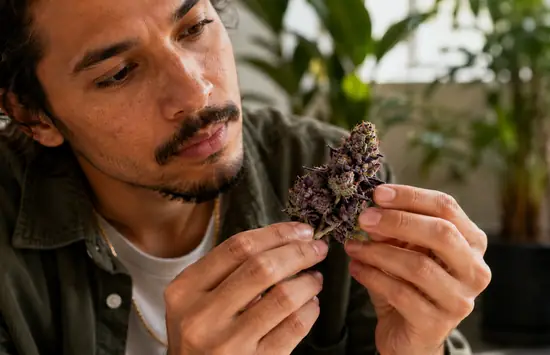
Why Some Cannabis Turns Purple: The Cold Weather and Anthocyanin Science
Walk into any decent dispensary and your eye snaps to the purple bud first. Deep violet, velvet black, frosted lavender, the kind of color that makes you reach for your phone before you reach for your wallet. Cannabis culture has spent decades chasing those hues, paying premiums for them, and arguing about what they actually mean. The answer isn't mysterious. It comes down to one family of pigments, a couple of cold nights at the end of flower, and a strain that detonated in California in 2003.
Why is weed purple? Meet anthocyanin
The pigment doing the work is called anthocyanin. Cannabis is not unique here. The exact same compound class makes blueberries blue, eggplants purple, red cabbage red, and concord grapes whatever color you want to call concord grapes. Anthocyanins are water-soluble flavonoids that live inside the vacuoles of plant cells, and they exist across most of the plant kingdom as defense compounds against UV exposure, cold stress, drought, and pathogen attack.
What is wild about anthocyanin is that the same molecule can appear in completely different colors depending on the chemistry around it. A typical anthocyanin pigment appears red in acid, violet in neutral solution, and blue in alkaline conditions, which is why red cabbage juice doubles as a homemade pH indicator in middle school science class. In cannabis the pigment usually settles into the violet-to-purple zone, but you will occasionally see strains that lean almost black or push toward red. That is all anthocyanin, just expressing differently depending on the cellular conditions around it.
The catch is that anthocyanin does not compete with chlorophyll head-on. Chlorophyll is louder, greener, and produced constantly throughout the grow. As long as the plant is pumping out chlorophyll, you see green. The purple is sitting there underneath the whole time. It only shows up once the green starts breaking down or the plant ramps up anthocyanin production in response to specific cues.
What makes weed turn purple? The cold weather connection
This is where the temperature thing comes in, and it is not folklore. The same chemistry that paints sugar maples red in October is what brings purple cannabis into its final color at harvest. As night length increases in autumn, chlorophyll production slows down and then stops, the existing chlorophyll breaks down, and the carotenoids and anthocyanins that were present or being produced are unmasked. Trapped sugars in the leaves feed anthocyanin synthesis, and the result is the autumn color show people drive hundreds of miles to see.
Cannabis follows the same basic playbook. During flowering, especially the last few weeks, cooler nighttime temperatures somewhere in the 50 to 65 degree Fahrenheit range act as a stress signal. The plant responds by switching on the genes that build anthocyanins. In one peer-reviewed experiment on related Brassica plants, low temperature treatment around 12 degrees Celsius greatly increased anthocyanin biosynthesis and produced visible purple coloration in seedlings within fifteen days of cold exposure. The same regulatory machinery that drives that response is conserved across a wide range of flowering plants, cannabis included.
Here is the part most growers learn the hard way: cold alone does not do it. If the genetics are not there, you can drop the temperature to whatever you want and the buds will stay green. You will just stress the plant and lose yield. Strains turn purple because they carry the genetic machinery to produce anthocyanins in volume, and temperature is the trigger that wakes that machinery up. No genes, no purple. It is the difference between a sugar maple and an oak. The maple was always going to go red.
Granddaddy Purple genetics and the rise of purple cannabis strains
You cannot talk about purple cannabis without talking about Granddaddy Purple. Ken Estes brought GDP to the San Francisco Bay Area in 2003 after a motorcycle accident left him paralyzed and looking for relief that pharmaceuticals were not giving him. The strain is most commonly cited as a Purple Urkle and Big Bud cross, though Estes himself has at times attributed it to a Mendo Purps, Skunk, and Afghan combination. The argument about which version is the original has rolled on for two decades and shows no sign of resolving.
What is not in dispute is the impact. GDP locked in two things that purple cannabis had not really nailed before: deep, consistent violet expression across most phenotypes, and a grape-and-berry terpene profile that matched the visual. Before GDP, purple weed was often a few stray cola tips on an otherwise green plant. After GDP, you could expect entire jars of bud the color of crushed blackberries, with a sweet, almost candied nose to match.
The strain went on to win Best US Indica at the Denver High Times Cannabis Cup and spawned a whole lineage of children that still dominate dispensary shelves today. The grape-and-berry template GDP locked in became the standard every purple breeder has been chasing or reacting against ever since, and most modern purple genetics in California trace at least part of their pedigree back through it.
Are purple cannabis strains stronger than green ones?
Short answer: no. Long answer: this myth is so persistent that we have to keep saying no.
Anthocyanin is a flavonoid. THC is a cannabinoid. They are built through entirely different biosynthetic pathways inside the plant. The genes that paint a bud purple are not the genes that build the cannabinoids you came for. A green strain can absolutely outpunch a purple one on potency, and plenty of high-THC commercial cuts have zero visible violet pigment at all.
Where the confusion comes from is correlation, not causation. A lot of foundational purple genetics trace back to indica-leaning landrace populations from Afghanistan and the Hindu Kush, plants that also tend toward heavy, sedating effects. People remembered the couch-lock, looked at the purple, and connected the wrong dots. The couch-lock came from the indica side. The purple came from the anthocyanin side. They share a family tree but they do not share a mechanism.
Worth keeping in mind: pushing a plant cold enough to maximize purple expression can actually hurt cannabinoid and terpene output if you take it too far. Cold stress is still stress, and a shivering plant is not putting its energy into resin production.
What purple actually tells you about a strain
Color is not useless information. It just tells you something different from what most people assume.
When a bud comes out properly purple, you are usually looking at one of two things. Either the genetics carry strong anthocyanin expression and the plant finished in conditions cool enough to let it show, or the breeder selected hard for that trait over many generations and the plant will go purple in pretty much any reasonable conditions. The second category is rarer and tends to come from breeders who have been at this for decades.
You also tend to get associated terpene profiles. Many purple strains lean into myrcene, linalool, and caryophyllene, which give you that grape-berry-floral nose that pairs visually with the violet bud. Purple Punch, a 90% indica Larry OG cross we carry in our US catalog, is a clean example of how that trifecta lines up. The buds finish in a deep purple with bright orange pistils, the smell is straight grape soda baked into a sheet of caramelized sugar leaves, and the effect tracks more from the indica-heavy genetics than from the pigment itself.
What color will not tell you is THC percentage, smoke quality, whether the cure was rushed, whether the plant was actually grown well, or whether the terpene profile survived drying. The only way to know any of that is the lab work and the puff. Color is the trailer. The full feature is the smoke.
Cold nights, real purple, and the work behind the color
This is where Barney's Farm has spent the last three decades doing the boring side of the romance. Anthocyanin expression is not just a question of dropping the thermostat in week seven. It is about stable genetics that produce predictable purple, season after season, across thousands of phenotypes, from California outdoor plots to Northern European indoor tents under LED.
We have crossed, backcrossed, and stabilized purple-expressing parents since the early 1990s in Amsterdam. Ayahuasca Purple, our 100% indica cross of Master Kush and Red River Delta, is a clean example of what that work produces outside the California lineage. The buds finish in deep violet across phenotypes, not just on one lucky cutting, and the genetics push hard whether you drop the night temps or not. The colder the nights at flower, the harder the color comes forward. The genetics have to be there first.
That is the whole story of purple weed in a few sentences. Pigment sitting in the leaves, cold air arriving at night, and a long lineage of breeders chasing a specific bag of grape candy on a stem. The science is straightforward. The execution is the part that takes thirty years.
Barney's Farm has been developing premium cannabis genetics since the 1980s, with over 40 Cannabis Cup wins. Explore our full cannabis seed catalog and find strains bred for every climate and skill level.